





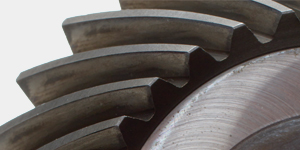


Crossed axis helical gears (Figure 1), otherwise called screw gears, have been known as long as parallel axis helical gears for at least two centuries. However, unlike parallel axis helical gears, their application is limited by insufficient load-carrying capacity due to low wear resistance (Figure 2) resulting from tooth sliding and point tooth contact which leads to high Hertzian contact stress.
1 Introduction
This study focuses on minimizing Hertzian contact stress and to identify a manufacturing-friendly gear tooth geometry that maximizes the load-carrying capacity of crossed axis helical gears.
According to [1], a ZI involute helicoid worm and a helical gear make point contact, while a ZI involute helicoid worm and a conjugated enveloping worm wheel are in line contact. The proposed enveloping helical gear resembles a worm wheel engaged with a helical gear instead of a ZI involute helicoid worm (Figure 3).

The worm wheel teeth are machined by a generating worm (worm gear hob), similar to the mating ZI worm. The enveloping helical gear tooth geometry can be defined the same way. However, the worm wheel is typically made of copper alloy (brass or bronze) that conforms during run-in, compensating for gear tolerances, probable assembly misalignment, gear tooth, and body deflection.
The hardened steel enveloping helical gear requires tooth contact localization to avoid edge contact. Different options for tooth profile and lead crowning are applicable. This study considers two such options. The first one is when the generating helical gear has a higher number of teeth than the mating helical pinion, thereby providing point contact, i.e., localized contact. The second considered option is when the enveloping crossed helical gear is generated by a helical gear with the same number of teeth as the mating pinion, resulting in line tooth contact. In this case, localized point tooth contact is achieved through the mating helical pinion lead crowning.

2 Hertz contact stress definition by Roark’s formulas
Modern gear design standards use Hertzian pressure as the basis for contact stress calculations [2, 3]. The same methodology applies to defining the contact stress of enveloping crossed helical gears, using Roark’s formulas for Hertzian stress and strain calculations [4].
For the conventional and localized contact enveloping crossed axis helical gears, the general case of two elastic bodies in point contact is applicable (Figure 4).
The 1/R1 and 1/R1‘ are principal curvatures of body 1 and 1/R2 and 1/R2‘ of body 2. The principal curvatures of each body are mutually perpendicular. The radii are positive if the center of curvature is within the given body, i.e., the surface is convex, and negative otherwise.
The major c and minor d contact ellipsis semiaxes, and S contact area are calculated in Equations 1:

The maximum Hertzian contact stress is calculated in Equation 2:

The material property factor is calculated in Equation 3:

Where:
E1 and E2, and ν1 and ν2 – moduli of elasticity and Poisson ratios of the body 1 and 2 materials.
The geometry factor is calculated in Equation 4:

The contact stress factor CSC is calculated in Equation 5:

The α, β, and γ coefficients are from Table 1 [4] in which Equation 6 is used:

Table 1 is inconvenient for practical calculations. Instead, a spline interpolation function defines the α and β coefficients.

Figure 5 presents the helical pinion and gear tooth flanks in contact; the minor (Plane 1) and major (Plane 2) curvature radii cross-sections are shown at the pitch contact point of the conventional (a) and localized enveloping (b) crossed helical gear pairs.
Figures 6a and 6b show Plane 1 of Figures 5a and 5b with the minor curvature radii R1 and R2 cross-sections. Plane 1 is normal to the helical tooth spiral lines of the mating gears at the contact pitch point. The dashed lines represent the virtual spur gear tooth tip diameters, indicating that the conventional crossed axis helical gear cross-section (a) resembles an external spur gear mesh with convexo-convex tooth contact, while the enveloping crossed axis helical gear cross-section (b) looks like an internal spur gear mesh with the convexo-concave tooth contact.

R1 and R1’ – contact point minor and major principal radii of curvature for body 1, and R2 and R2’ for body 2; f – angle between plane of radius R1 and plane of radius R2.
The minor radii of curvature R1 and R2 at the pitch point lay at the same normal plane to the tooth lines of both mating gears. It makes the angle φ between the radius R1 plane and the radius R2 plane equal to φ = 0°. Such location of the minor radii results in maximum Hertzian contact stress.
For the conventional crossed axis helical gear pair, the pitch point minor radii of curvature of the driving helical pinion and driven helical gears are calculated in Equations 7:

Where:
- βb – helix angle at the base diameters of both mating helical gears.
- αt – transverse pressure angle.
- α – normal pressure angle.
- β – helix angle at the pitch diameters of both mating helical gears.
For the localized enveloping crossed axis helical gear pair, the pitch point minor radius of curvature R1 of the driving helical pinion is defined by Equation 7, while the minor radius of curvature R2 at the pitch point is determined using the graphical-analytical method in Plane 1 (Figure 5b) of the enveloping helical 3D gear model.

Figures 7a and 7b show Plane 2 of Figures 5a and 5b with the major curvature radii R1‘ and R2‘ cross-sections. Plane 2 is simultaneously perpendicular to Plane 1 and the mating gears tooth profiles at the contact pitch point. The radii R1‘ and R2‘ are also defined using the graphical-analytical method in Plane 2 (Figures 5a and 5b) of the of the conventional and enveloping helical 3D gear models.

Figures 6b and 7b show the concave minor and major curvatures of the enveloping helical gear, which result in the convexo-concave tooth contact with the helical pinion.
Table 2 presents the basic geometry parameters and material properties of the conventional and enveloping crossed axis helical gears. Table 3 shows the results of the Hertzian contact stress analysis using Roark’s Formulas at the pitch point of the conventional crossed axis helical gears and enveloping crossed axis helical gears with the localized point tooth contact, formed by the 18-tooth generating gear, and by the 17-tooth generating gear.

The tooth flank of the enveloping helical gear, formed by the 18-tooth generating gear, results in 0.004 mm profile crowning and 0.040 mm lead crowning. The mating helical pinion tooth flank has no crowning.
The tooth flank of the enveloping helical gear formed by the 17-tooth generating gear tooth flank has no crowning, but its mating helical pinion tooth flank has 0.025 mm lead crowning. The Hertz contact stress and contact ellipsis area of the conventional crossed axis helical gear pair is considered to be 100%.

and b – enveloping crossed helical gears; dash lines – virtual spur gear tooth tip diameters.
Figure 8 illustrates the contact ellipses of the conventional and enveloping crossed helical gears under 5.0 Nm pinion torque.
The load-carrying capacity factor FLC is a ratio of the adjusted pinion torque Ta1 to the pinion torque T1. Under the adjusted torque T1a, the maximum Hertz contact stress of the enveloping crossed helical gear pair equals the conventional crossed helical gear maximum Hertz contact stress under the pinion torque T1. See Equation 8:

For Roark’s formulas’ definition of the Hertz contact stress (Table 3), the conventional and enveloping crossed axis helical gear maximum Hertzian contact stress at the pitch point is proportional to the cubic root of the normal tooth load P (Equation 2). Then, the load-carrying capacity factor FLC for the conventional and enveloping crossed axis helical gear pairs with the point contact is calculated in Equation 9:

Where:
σcmaxC – maximum Hertzian contact stress of the conventional crossed axis helical gears.
σcmaxE – maximum Hertzian contact stress of the enveloping crossed axis helical gears.
The contact ellipses of conventional and enveloping crossed helical gears under adjusted pinion torque Ta1 are shown in Figure 9.

and b – localized enveloping crossed helical gears.
3 Loaded Tooth Contact Analysis (LTCA) of Crossed Axis Helical Gears
An LTCA computer program analyzes how the transmitted torque is shared between meshing gear tooth pairs and, from the resulting tooth loads, calculates the resulting contact and bending stresses. Additional information resulting from the LTCA often includes sliding friction, subsurface shear stress, lubricant film thickness, scoring, and scuffing probabilities. The BECAL [5, 6] and HyGEARS [7] software programs were used for the crossed axis helical gears LTCA to verify the contact stress reduction and the load-carrying capacity increase shown by the above Hertz contact stress analysis (Table 3).
3.1 BECAL LTCA
Since the late 1980s, the Institute of Geometry at TU Dresden has been developing methods for generating approximation surfaces for spiral bevel gears in collaboration with the Institute of Machine Elements (IMM). These efforts later evolved into a comprehensive program package called BECAL (BEvel gear CALculation), designed for rapid tooth contact analysis of bevel gears under load.

Initially, the approximation surfaces consisted exclusively of Bézier surfaces, which provided highly accurate representations of point clouds for classic spiral bevel gear teeth. These point clouds are generated using a tooth flank generator integrated into BECAL, which operates based on machine setting data from bevel gear machine tools. Local tooth deformations under load are determined using stiffness influence numbers, calculated via the Boundary Element Method (BEM) to achieve a practical load distribution.

These values have been calibrated through experimental gear measurements and Finite Element Method (FEM) calculations. Local equivalent cylinders are employed for precise local Hertzian pressure calculations, with curvatures originally determined in the normal section direction.
To accommodate complex modifications in flank geometry, capabilities are introduced to import external point clouds, which are also supported in the STEP file format. Additionally, enhancements in influence coefficient calculations for tooth deformations have been made. While using the local equivalent cylinders perpendicular to the contact line, it is now possible to analyze various bevel gears independently of machine setting data and a lot of other gear types, including conventional and enveloping crossed axis helical gears [6].
Table 4 presents the BECAL contact stress diagrams and maximum stresses of the conventional and enveloping crossed-axis helical driven gears for the same 5 Nm driving pinion torque.

3.2 HyGEARS™ LTCA
HyGEARS™ is a self-contained gear design and analysis software in which the gear teeth are digitized (or generated) from a set of cutter dimensions, machine settings, and machine movements such that one gets the exact same tooth flank topography that would be obtained if the same gear tooth was cut on a perfect machine with a perfect cutter [7].
For the enveloping helical gear, the shaping (generating) tool is either identical to the mating helical pinion, for line contact, or has a larger number of teeth for localized contact pattern on the tooth flank.
The following simplifications and assumptions are made:
- There is neither friction in the contact zone nor the presence of lubricant.
- Displacements due to tooth deflection, shearing, or contact deformation are sufficiently small that the tooth surface normal vector at the contact point is not affected.
- The HyGEARS TCA computer program is used to obtain the kinematical characteristics of the analyzed gear sets.
- The contact is Hertzian, and no boundary corrections are made for edge contact.

Tooth coupling effects are neglected.
In the HyGEARS LTCA, to establish the individual tooth loads at each meshing position, Equations 9 and 10 are solved using a Newton Raphson algorithm:

In other words:
- The rotation (subscript t in Equation 11 implies the transverse plane) caused by the initial tooth to tooth separation ΔS resulting from the TE, the contact deformation ΔH and the bending deflection ΔB must be the same between tooth pairs i-1, i and i+1.
- The sum of the individual torque Ti applied to each meshing tooth pair must equal the externally applied torque Tapp.

Table 5 presents the HyGEARS contact stress diagrams and maximum stresses of the conventional and enveloping crossed-axis helical driven gears for the same 5 Nm driving pinion torque.

4 Enveloping helical gear contact stress and load-carrying capacity evaluation
Table 6 summarizes the maximum contact stress reduction and the load-carrying capacity increase for conventional and enveloping crossed axis helical gears, as determined by the Hertz equations, and the BECAL and HyGEARS software. The contact stress values for the conventional crossed axis helical gears, calculated using Hertz equations, the BECAL, and the HyGEARS LTCA, are assumed to be 100%.

2 – gear hob.
The evaluation results show a noticeable trend in contact stress reduction and increased load-carrying capacity for enveloping crossed axis helical gears compared to conventional crossed axis helical gears, despite considerable variance in maximum contact stress values depending on the calculation method.
5 Enveloping helical gear manufacturing methods
The presented enveloping helical gears evolved from the worm wheels, which are machined by the gear hob similar to the mating ZI worm. The generating gear used to define the enveloping helical gear tooth topography has a tooth count equal to or slightly greater than the mating helical pinion. However, using a gear hob with such a high number of starts, as the number of teeth of the generating gear, would be impractical.

Instead, a gear hob with a reasonable number of starts (e.g., 1, 2, 3, or 4) should be used. In this case, the hob and hobbing machine setup parameters must be defined to achieve the desired enveloping helical gear tooth topography. Figure 10 illustrates the hobbing setup for an enveloping helical gear.
Finishing machining of enveloping helical gears (Figure 11) may involve tooth honing or grinding using a helical gear-shaped tool.
Other enveloping helical gear machining technologies, such as CNC milling (Figure 12), can also be considered.

6 Summary
- The presented study of the load-carrying capacity of the enveloping crossed axis helical gears uses the Roark’s formulas for the Hertz contact stress calculation.
- The study results indicate the possibility of considerable increase in load-carrying capacity achieved by replacing the convexo-convex tooth contact of the conventional crossed axis helical gears with the convexo-concave tooth contact of the enveloping crossed axis helical gears, with a significant increase in the tooth contact area.
- The BECAL and HyGEARS™ LTCA results of enveloping crossed axis helical gears validate the contact stress reduction and load-carrying capacity increase trends shown by the Roark’s formulas.
- Enveloping crossed axis helical gears can be manufactured using the same machining methods, machines, and tools as traditional helical and worm gears.
- Results of this study support the potential application of enveloping crossed axis helical gears in moderate to highly loaded gear drives.
References
- Liyang Dong, Pingyi Liu, Wenjun Wei, Xuezhu Dong, Haitao Li, Study on ZI worm and helical gear drive with large transmission ratio, Mechanism and Machine Theory, Volume 74, April 2014, pages 299-309.
- ANSI/AGMA 2001-D04. 2016. Fundamental Rating Factors and Calculation Methods for Involute Spur and Helical Gear Teeth. Alexandria, VA: AGMA.
- ISO 6336-2:2019, Calculation of load capacity of spur and helical gears, Part 2: Calculation of surface durability (pitting), Switzerland: ISO Copyright Office.
- W. C. Young and R. G. Budynas, Roark’s Formulas for Stress and Strain, Seventh Edition. McGraw-Hill. New York, 2002, 854 p.
- H. Linke et al., The Development of the Program BECAL– an Efficient Tool for Calculating the Stress of Spiral Bevel Gears, International Conference on Mechanical Transmissions, April 5–9, 2001, Chongqing, China.
- Wolf W. Wagner: Hypoidverzahnungen in der Mehrkörpersystemsimulation. Dissertation Technische Universität Dresden. 2024
- C. Gosselin, L. Cloutier, Q.D. Nguyen, A General Formulation for the Calculation of the Load Sharing and Transmission Error Under Load of Spiral Bevel and Hypoid Gears, IFTOMM Mech. Mach. Theory Vol 30, No 3, pp. 433-450, 1995.


