





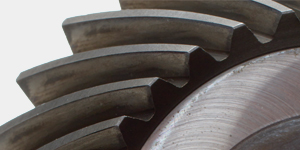



The question of choice between tapered or uniform tooth depth in bevel gear design persists in engineering discourse. In straight bevel gears, the tooth profile remains consistent along the lead, with the module attaining its maximum at the heel (outer diameter) and diminishing toward the toe (inner diameter).
Spiral bevel gears incorporate a spiral angle, nominally defined at mid-face width, which usually increases toward the heel and decreases toward the toe (with inverse spiral bevel gears being an exception). These variations influence tooth profiles, thereby affecting load distribution, noise levels, and wear characteristics; thus, key issues are identified and will be discussed through a practical calculation example.

Straight Bevel Gears
Figure 1 illustrates a straight-tooth bevel pinion across three sections — outer, middle, and inner —depicting tooth profiles along the pitch cone. Conforming to established engineering standards, its parameters are detailed in Table 1, Set I. Black lines denote tapered tooth depth; pink indicates changes induced by introducing uniform tooth depth. Light blue marks the terminus of the octoid flank and onset of the root fillet.
Tooth depths match for both configurations at mid-face width. Uniform depth results in shallower outer teeth (reducing profile contact ratio from 1.42 to 1.24 and excessively broadening the tip) and sharpened inner tips with minor root deepening (potentially compromising bending strength). The inner-tip sharpening renders uniform depth unacceptable. Given the 0° tooth line angle in straight bevel gears, flank profiles across sections are scaled equivalents, maintaining proportional dimensions and pressure angle invariance. Uniform depth offers no major manufacturing advantages here. Consequently, tapered tooth depth prevails in straight bevel applications.

Spiral Bevel Gears
Figure 2 presents a spiral bevel pinion per Table 1, Set II, adhering to engineering standards with consistent color coding. Spiral gears exhibit variable spiral angles along tooth length: nominal value (35° in this case) at mid-face, reduced at the toe and elevated at the heel (per Table 1).

This variation modifies tooth profiles, with increasing spiral angle widening the root and narrowing the tip. Such design achieves more uniform tip widths, enhancing manufacturability, particularly for case-hardened gears. Heel-side teeth exhibit improved bending strength due to thicker roots and elevated pressure angles — a desirable trait, as displacements under load tend to migrate the contact pattern toward the heel. Uniform depth (pink) induces excessive heel tip widening and root thickening (bolstering bending strength yet diminishing profile contact ratio from 1.07 to 0.89).
At the toe, tip narrowing may necessitate increasing the face cone angle or adding a face cone chamfer to reduce tooth height there, at the cost of reduced profile contact ratio. Without such modifications, the profile contact ratio increases from 1.02 to 1.28, although bending strength declines due to root undercutting. Aggregate contact ratios depend on further parameters (such as tooth flank microgeometry or displacements under loads) and typically approximate 2.0 or higher for tapered (versus 1.42 for straight tapered) and slightly below 2.0 for uniform, representing a significant advancement. Therefore, both tooth depth configurations are applicable to spiral bevel gears.
High-Tooth-Count Spiral Bevel Gears
Figure 3 considers spiral bevels with doubled tooth numbers (Table 1, Set III), while preserving the macrogeometry parameters such as pitch diameter, pitch cone angle, and face width. Tip widths achieve greater uniformity in this case. Furthermore, uniform depth avoids root undercutting and resulting bending strength deficits, with profile contact ratio enhancement. Elevated tooth counts increase overlap contact ratio through finer pitches. The strength calculation method must be capable of taking the simultaneous contact of many teeth pairs into account to evaluate the way the load is shared between multiple finer teeth. It adds complexity as load-sharing pattern depends on many factors, of which some may be impossible to determine at the design stage.
Toe-side teeth still have possibility to accommodate face cone angle increases or face cone chamfers for improving the tip width uniformity without critical contact loss. Total contact ratios attain approximately 3.7 (tapered) and 3.6 (uniform). This approach is typically employed in large gears constrained by hobbing module limits, necessitating higher tooth counts.

Conclusion: Tapered as the Preferred Geometry
Tapered tooth depth aligns inherently with pitch cones — the imaginary bodies rolling without slip. Uniform depth typically impairs meshing performance but may be justified for manufacturing considerations, such as simplified calculation of machine setups, or continuous hobbing for more balanced cutting (notably for large case-hardened gears where tapered hobbing is unavailable, for hard finishing with hobbing). Implementation of uniform tooth depth geometry requires rigorous verification to ensure compliance with design specifications for the intended application.


