








As we roll into the summertime, those of us who live on the Eastern seaboard of the United States look forward to lazy days at the beach. Part of the tradition of spending a day of fun in the sun is to stop by a local shop and order a sandwich for lunch. Regardless of whether you order a hero, or a sub, or a grinder, or a hoagie, each of these sandwiches include fresh sliced deli meats piled high with cheese, onions, lettuce, tomatoes, and sometimes pickles or olives. With a dash of olive oil or some mayonnaise or mustard, this sandwich satisfies the hunger of the day. Never would you order such a sandwich on sliced bread.

The phrase “the greatest thing since sliced bread” is frequently used to describe something or someone that is better than some prior thing or person. But why do we compare everything to sliced bread? Aren’t there other modern conveniences that are more significant in their impact to society? One such convenience was the “discovery” of the wheel. The wheel — simply a flat, round disc — was revolutionary in the transmission of motion. By adding two wheels to an axle, you could then mount a cart to that axle and use the rotation of the wheels to move objects over a long distance with significantly less energy. Thus was the invention of the first direct drive transmission.
After many years, inspiration struck again, and the cog was developed. A cog is simply a wheel which has some projections on its outer edge that helps to transfer motion by engaging with another surface (Figure 1). The projection can be any shape or profile.

An improvement in the simple cog design is that of a sprocket. Sprockets are cogs that have a specific tooth form that permits a chain to engage with the sprocket teeth (Figure 2). This engagement allows the motion to be transmitted over a longer distance. Sprockets have specific-sized teeth that are designed to fit specifically sized roller chain.
The most common application for roller chain sprockets is in transmissions on bicycles and motorcycles. With the positive engagement between the chain and the sprocket teeth, these drive systems can transmit significant amounts of torque.
Similar to the chain sprocket is the timing pulley. A pulley is a cog that has teeth that are specifically designed to engage with a belt. A belt and pulley design (Figure 3) is more flexible than that of a chain and sprocket, as the belt can be placed in paths where a chain would not fit. Pulley systems are quieter than sprocket systems because the materials used for the belt are typically rubber or plastic, whereas most chains are metallic. Pulleys are designated by the pitch profile of their teeth. These tooth profiles are specific to the profile of the mating timing belt and, although some profiles are the same numeric value — i.e., 3mm — they may not have the same shape.

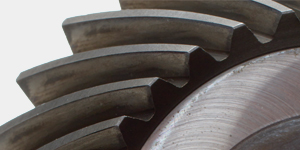
A gear is the most technical form of a cog. A gear has teeth of a specific shape that permits it to only engage with another gear that has the same-shaped teeth Figure 4). The most common shape for gear teeth is established by the involute curve. This shape optimizes the transmission of motion between the two components. Gears must share not only the same pitch, but the same pressure angle in order to engage properly.
Regarding cogs, there are several important relationships to understand: Although a gear is a cog, it is not a pulley or a sprocket, as it will not engage with a belt or a chain. Although a pulley is a cog, it is not a gear or a sprocket, as it will not engage with another pulley or a chain. Likewise, a sprocket is a cog, but is not a pulley or a gear, as it will not engage with a belt or with another sprocket. Thus, the following phrases are never correct:
- I need a belt for this gear.
- I need a chain for this gear.
- I need a chain for this pulley.
- I need a belt for this sprocket.

So, when heading to the surf this summer, feel free to order your favorite sandwich made however you like it. But remember the proper term. Is it a hoagie or a hero? Is it a sub or a grinder? If it has to be on sliced bread, I will take my sandwich as pastrami on rye with Swiss and mustard.


