





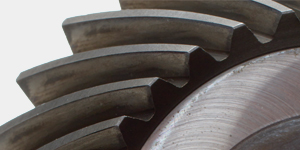



Quench presses are widely used in the heat treatment of carburized and through‑hardened steel gears to control distortion. In this article, I will review the basics of quench pressing gears.
During the normal heat-treating process for gears, whether neutral or through hardening or carburized gears, during quenching, there is the transformation of austenite to martensite, with the accompanying volume expansion of approximately four percent. In carburized gears, the high carbon shell will expand, while the inner core experiences little if any volume change due to the transformation to ferrite and pearlite. There is the contraction from temperature change (thermal stress), and the expansion due to transformation stresses. Due to the non-linear aspect of quenching, the heat transfer from the gear varies in position and time. This results in different time-temperature profiles across a part.
These non-uniform thermal and transformational stresses can cause substantial distortion and residual stresses, resulting in changes in flatness, roundness, and the tooth profiles. The resulting distortion can change throughout the furnace load, depending on the position of the part in the furnace load [1] [2]. Press quenching addresses this by combining rapid quenching with mechanical restraint to minimize dimensional changes [3].
The Quench Press
A quench press applies a controlled mechanical restraint to a hot gear while at the same time directing quenchant flow around the part. To achieve the necessary clamping force, quench presses are either pneumatic or hydraulic. However, hydraulic operated quench presses are preferred because of the ability to achieve higher clamping forces and better control [3] [4]. A typical quench press is shown in Figure 1.

A typical quench press has several basic components: a lower die assembly; an upper die assembly; the quench chamber and oil reservoir; and the control system. The lower die assembly carries gear-specific tooling. It also contains passages for the upward flow of quenchant around the part. The upper die assembly provides the clamping force to the gear. It consists of inner and outer dies or rings. It may also have a central ram for bore control. Each of these components (inner and outer rings, and central ram) have independent control of the force and timing of the individual components. The quench system contains the necessary volume of quenchant for the quench press, plus the necessary pumps to drive the quenchant through the press and around the part. The control system contains proportional valves, pressure transducers, position encoders, and often a programmable controller or PLC to define force‑time and flow‑time profiles. This is schematically shown in Figure 2.
For gears, there are several dimensional targets. First, there is the flatness of the gear faces, and parallelism of the gear faces. Second, the ovality and the size of the central bore and bearing face diameters must be controlled. Thirdly, the amount of bowing across thin webs and flanges must be controlled. Lastly, the radial growth of the gear teeth is to be minimized.

Because transformation occurs over a range of temperatures and times, it is necessary to tailor force changes with expected transformation intervals, such as increasing clamping after the start of martensite formation while avoiding excessive restraint at higher temperatures where plastic deformation is prominent. The proper control scheme allows timed segments to map these phases to achieve low distortion [4] [5] [6].
While in conventional heat treatment, a batch of parts is quenched, then transferred to the tempering furnace, in press quenching, a part is quenched one at a time. The part is transferred from the furnace (batch, rotary, or pusher furnace) and is transferred manually or automatically to the quench press and placed on the lower die assembly. The upper dies then clamp the part, and the quenchant flow is initiated. During the quench cycle, the process controller regulates the clamping forces, and oil flow rates as part of a quench recipe for the specific part [3].
Practical Considerations
While press quenching can control distortion in many applications, an understanding of some of the practical limitations of press quenching should be considered.
- Part size and geometry. The gear must fit within the press working envelope, and extremely complex shapes may require compromises in tooling design.
- Surface damage risk. Excessive local loads or misalignment can cause imprinting or plastic deformation at contact surfaces, necessitating careful control of pressures and tooling contact area.
- Residual stress and cracking. Over‑constraining the gear, especially at high temperatures, can increase internal stresses and potentially promote quench cracking, so recipes must balance restraint with stress levels.
- Cost and throughput. Press quenching equipment, tooling, and setup are more expensive and complex than open-oil quenching, and cycle times are often longer, so the method is primarily justified where high precision or reduced post‑hardening machining is critical.
Even with proper quench press die design and process cycle optimization, it is often not possible to eliminate gear distortion. All the processes upstream of the heat-treatment cycle must be taken into consideration. This includes the material specification [2], the forging practice, prior microstructure[3], machining practice [2] and work holding practice, as well as the quenchant used [6] and its condition[7] [8] [9].
Conclusion
Quench presses can be effectively used to control distortion in gears. However, this is a more expensive method, requiring one-at-a-time processing as opposed to batch processing in a conventional integral quench furnace. Further, specialized dies are often required for specific parts, further increasing costs. However, quench presses can dramatically reduce the amount of distortion over batch quenching.
Please contact the editor or myself should you have any questions regarding this article, or for suggestions for further articles.
References
- D. S. MacKenzie, Z. Li and B. L. Ferguson, “Effect of Quenchant Flow on the Distortion of Carburized Automotive Pinion Gears,” HTM, vol. 63, no. 1, pp. 15-21, 2008.
- D. S. MacKenzie, “Metallurgical Aspects of Distortion and Residual Stresses in Heat Treated Parts,” in 23rd IFHTSE Heat Treatment and Surface Engineering Congress, April 18-21, Savannah, GA, 2016.
- A. Readon, “Controlling Distortion in Heat Treatment Through Press Quenching,” Thermal Processing, no. April, pp. 24-29, 2015.
- G. Hewett, “The Mechanics of Press Quenching,” Heat Treatment of Metals, no. 4, pp. 88-91, 1979.
- Y. Wang, Z. Zhao, J. Liu, X. Tu and S. Liu, “A Temperature Field Simulation of the Pressure Quenching Process of 18Cr2Ni2MoVNbA Gears,” Metals, vol. 15, no. 4, p. 443, 2025.
- N. Bugliarello, C. Zimmerman, S. Richardson, R. Perkins, D. McCurdy, D. Giessel and B. George, “Heat Treat Processes for Gears,” Gear Solutions, no. July, pp. 38-51, 2010.
- B. L. Ferguson and D. S. MacKenzie, “Effect of Oil Contamination on Pinion Gear Distortion,” in Proceedings from the 6th International Quenching and Control of Distortion Conference, 9-13 September, Chicago, IL, 2012.
- D. S. MacKenzie, “Care and Maintenance of Oil Quenchants used for Quenching Automotive Components,” in European Conference on Heat Treatment and Surface Engineering, 11-13 May, Prague, Czech Republic, 2016.
- D. S. MacKenzie, “Effect of Contamination On the Heat Transfer of Quench Oils,” in 6th International Conference on Quenching and Control of Distortion, 9-11 September, Chicago, IL, 2012.
- D. S. MacKenzie, “Distortion and Residual Stress development during Quenching,” Gear Solutions, no. April, pp. 26-27, 2025.
- D. S. MacKenzie, A. Kumar, H. Metwally, S. Painganker, Z. Li and B. L. Ferguson, “Prediction of Distortion of Automotive Pinion Gears during Quenching Using CFD and FEA,” J. ASTM Intl., vol. 6, no. 1, pp. 1-10, 2009.
- J. Sims, “Press quenching tooling design using simulation,” Thermal Processing, no. Dec., pp. 18-20, 2021.
- D. S. MacKenzie, “Control of Residual Stress and Distortion,” Heat Treating Progress, p. 47, July 2007.
- D. S. MacKenzie and B. L. Ferguson, “Effect of Alloy on the Distortion of Oil Quenched Automotive Pinion Gears,” in International Conference on Thermal Process Modeling and Computer Simulation, Shanghai, China, 2010.


