




Reshoring is gaining momentum as shifting global economic conditions are forcing manufacturers to reevaluate their supply chains, and gear-forging operations are ely in the spotlight. Forged gears are widely used in automotive transmissions, aerospace systems, heavy machinery, wind turbines, and industrial gearboxes, where high-power transmission and long-term reliability are essential.
At the same time, policy and pricing pressures are reshaping the competitive landscape. Tariffs on steel and other metals have raised the cost of imports, making domestic forging operations more competitive. In addition, “Buy America” provisions and other government trade measures are incentivizing companies to source gears domestically, both to remain compliant with regulations and to reduce the uncertainty that comes with fluctuating tariffs and duties on foreign goods.
With these pressures in increasing demand, manufacturers are now facing longer lead times for new or custom forging presses and hammers. Fortunately, manufacturers have more than one path forward and investing in brand-new equipment is not the only solution.

Forged Gears and Typical Applications
Forging is commonly used for gears that are expected to carry high loads and operate for long periods of time, such as spur gears, helical gears, bevel gears, and ring gears.
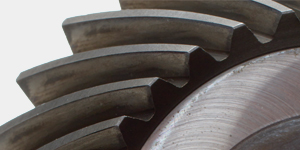
One reason forging is used is the grain structure. During forging, the grain flows with the shape of the part. This improves strength and fatigue resistance compared to gears machined from bar stock or produced as castings.
Large gears and pinions are also frequently forged. These include components used in wind turbines, mining equipment, marine drives, and steel mill machinery. In these applications, gears are exposed to continuous torque and, in many cases, shock loading. Durability is a primary concern, and forged gears are often selected for that reason.
Rebuilt Forging Equipment
Today, many forgers are turning to the revitalization of idle or underutilized machinery, commissioning complete rebuilds from OEMs. This approach allows production to scale up far more quickly while new forging equipment is still on order.

“Rebuilding is often the fastest, most economical means to get worn or mothballed equipment back into production when purchasing new equipment may not be feasible,” says Bill Goodwin, Vice President of Sales, Ajax-CECO-Erie Press (ACE), the largest forging equipment supplier in North America, founded in 1875. The company has more than a century of experience in custom designing and building presses and forging machines spanning horizontal, vertical, mechanical, hammer, and hydraulic forging presses for a variety of applications.
According to Goodwin, rebuilding entails removing all a machine’s parts and repairing or replacing them with OEM components to return them to manufacturer specifications. Recognizing that the high-impact nature of forging takes its toll on parts over time, a rebuild typically includes replacing high-wear items such as bearings, bushings, seals, and liners and inspecting and repairing the frame.
Often more efficient and cost-effective than purchasing new forging equipment, rebuilding is ideal for quickly getting equipment operational again, often in as little as just a few months.
Rebuilding can even be an effective option for older forging equipment, including updates and modifications for new product lines or restoration to original specifications. A rebuild can also increase the production capacity of slow and inefficient equipment.

Cost and delivery time are usually the first things considered when rebuilding forging equipment, but they are not the only factors. Forging presses and hammers operate under extreme loads. Over time, wear shows up in ways that may not be obvious. Alignment shifts. Clearances open up. Force is no longer applied the same way it was when the machine was new.
When this happens, part consistency can suffer. In some cases, problems do not show up until parts are already in service. For manufacturers supplying gears for aerospace, defense, energy, or heavy industrial markets, this level of uncertainty is not acceptable. These applications demand stable processes and repeatable results.
Restoring equipment to its original OEM specifications returns the process to established, well-documented operating conditions. Loads, tolerances, and machine performance are clearly defined and understood, which minimizes uncertainty on the production floor. As a result, scrap rates are easier to manage, operational risk is reduced, and downtime can be anticipated and planned with greater accuracy.

Optimizing the Rebuild
When electing to rebuild, manufacturers can choose to contact the OEM to rebuild the equipment or contract with a third-party rebuilder. The decision is significant, given the need for a complete, dependable rebuild that will perform as expected for many years.
Rebuilders often use a reverse engineering process to create their parts or have them machined at local CNC shops. Although this approach may work in the short term to “get equipment up and running,” it ignores the long-term view. Even rebuilders with experience working on various other types of equipment, such as stamping presses or injecting molding machines, may only partially appreciate the forces exerted during the forging operation.
Moreover, critical engineering design data is lost when an independent rebuilder reverse-engineers a part, resulting in inferior part construction and premature wear or component failure.
“Often they are rebuilding a machine without truly understanding the original design intent or the loads that will be placed on the parts and equipment,” Goodwin said.
As an alternative, it can be advantageous to work with the OEM for an equipment rebuild. The OEM has the original design specifications, critical materials, and clearance specifications to jump on rebuilds and quickly finish the work.

A vast range of information is required for a quality rebuild, such as critical data on high-wear parts, the material grade of the steel, the heat-treating process used, and the required clearances used in that forger’s engineering.
When working with the OEM, a rebuild is not limited to restoring the original design capabilities to today’s standards but can also include significant automation upgrades.
“A rebuild can be approached in several ways,” Goodwin said. “The forging equipment can be sent to us for rebuilding; we can send repair personnel to the manufacturer’s facility to rebuild equipment on-site, or we can supervise a rebuild by their maintenance staff.” Whichever option a manufacturer selects, revitalizing old and un-used forging equipment with an OEM can reclaim much needed capabilities from existing and dormant assets in a timely and cost-effective manner to meet increased demand for domestic gear forging capacity in the years to come.


