





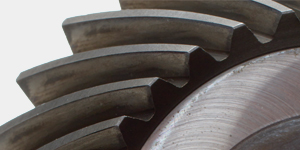

The industry has seen a significant rise in the power density of geared components to increase cost efficiency in gearboxes.
It is feasible to increase torque density with a combination of technology, improved design, optimized materials, and surface engineering (Figure 1).

Since fatigue failures nearly always occur at or near the surface, where the stresses are greatest, the surface condition strongly affects the gear life. Consequently, an improved surface condition effectively avoids major redesign or increased material cost due to an increase in part size.
Additional finishing methods such as shot peening (SP) and superfinishing (SF) significantly increase the gear load capacity, but these effects have not yet been adequately considered in the current ISO 6336 standard or in any other gear standards.
The combination of SP followed by SF will be described here as an “improved gear surface” (IGS).
The potential use of an improved surface condition as a repair technique is also relevant. A repair finishing process including shot peening (SP) followed by superfinishing (SF) can extend the service life of originally ground gear parts, reducing costs and lead times even in the presence of remaining local dents.
1 IGS definition
1.1 Shot Peening
The objective of shot peening is to induce compressive residual stresses in the near-surface layer of a part. This occurs by a propelled stream of spherical shots, often called media. Each impact of the shot media has the effect of leaving a small hemisphere or dimple and compressive residual stresses that occur from localized yielding of the base material at the point of shot impact.
Shot peening is a controlled process, and, according to ISO6336-5, the recommended minimum control should be based on SAE AMS 2430 [3], SAE AMS 2432 [4], or SAE J 2441 [5]. Shot peening should not be confused with mechanical cleaning operations or shot blasting.
There are four main parameters to specify and control shot peening: media hardness, media size, intensity, and coverage [2].
High near-surface compressive RS can increase tooth root bending strength, and therefore, this technique is used frequently in different applications, for example, in the wind industry on planet gears [14].
1.2 Superfinishing (SF)
Superfinishing (SF) is a polishing process that removes surface roughness peaks due to a relative movement between the workpiece and an abrasive media in a vibrating barrel (bowls or tubes). The reduction in roughness depends on the initial roughness and processing time.
Superfinishing can be subdivided into mechanically and chemically accelerated processes.
1.3 Combined effect of SP + SF (IGS)
Shot peening can be detrimental to surface durability due to an increase in surface roughness. It may therefore be required to refinish the tooth flanks to achieve the specified surface finish and texture, as stated in ISO 6336-5 [1].
Postshot peening processes are allowed but, in general, can alter the residual compressive stress obtained by SP.
Superfinishing reduces the surface roughness without significantly changing the residual stress state below the surface because of the small amount of material removed. Therefore, superfinishing allows preservation of the compressive residual stresses induced by a shot peening process and improves flank surface roughness requirements.
2 Case study
The scope of this study was a comparison of the pitting performance of test gears depending on their flank surface condition. This included a reference test run with a ground gear pair (a pinion and a conjugate meshing gear wheel), as well as two test runs with improved gear surface condition (IGS). The gear running tests were performed on a FZG test rig (Figure 2).


Tested parts were cased hardened gears. The first set (V1) are standard FZG ground finished parts. The second and third gear sets (V2, V3) are equal to gear set V1, but with an additional IGS finishing process. Both IGS treated sets (V2, V3) followed the same shot peening and superfinishing processes and parameters. The only difference of variant V2 is that gear pinion was intentionally pre-damaged, with dents on three teeth at different heights. Dents cover approximately 5 percent of the gear-teeth meshing surface.
Beyond surface roughness values, the topography of gear surface is completely changed between ground gears (V1) and shot peening followed by superfinished ones (V2, V3). The IGS process creates a non-directional surface pattern (isotropic) that differs from the standard ground anisotropic condition (Figure 4).

3 Results of the Experimental Investigations
The test runs were performed on the same FZG-back-to-back test rig and under the same test conditions (torque, speed, lubricant, temperature, etc.) after each other.
Figure 5 summarizes the test results.

The reference test run V1 failed due to typical pitting damage within the expected lifetime. Similar load cycles until failure have been observed in several projects for comparable test gears and test conditions, e.g., FVA 521 I [6].
The test run V3, which has been performed with IGS-treated gears, did significantly surpass the reference V1 and did not fail even after 50 million load cycles. After the test run has been stopped, the surface of the tooth flank did not show any pitting or micropitting, as shown in Figure 5. As expected, full film lubrication has been established due to the decreased surface roughness of the tooth flanks.
The test run V2, which also has been performed with IGS-treated gears, failed after 34 million load cycles. The tooth flank picture in Figure 5 shows the pitting damage occurred on the edge of the prepared dent. Therefore, it can be concluded the dents worked in favor of the damage and that without the dents, the test run would probably have reached 50 million load cycles without damage, as in V3. It can also be concluded that, without IGS, this variant would have failed prior to 12 million cycles, and thanks to that improved surface condition variant,V2 did surpass the reference (V1) by a factor of about three.
Results of the IGS.D variant are consistent with results obtained by other researchers who have shown shot peening can retard or prevent microcrack propagation [11,12]; therefore, SP can be considered to be an appropriate technique for repairing local defects. The IGS.D result shows the additional gear capacity obtained through the combination of SP and SF can compensate for the existence of local defects, such as those that, in some cases, appear to be recovered in gear parts during corrective maintenance.
Correct preparation of the indentation edge prior to IGS is critical to achieve the reported IGS.D results. Other samples were tested without removing sharp edges prior to SP, and the results changed dramatically, as shown in Figure 6.

4 Conclusions
The scope of this study was a comparison of the pitting performance of test gears depending on their flank surface condition. This included a reference test run with a ground gear pair, as well as two test runs with gears specially treated with IGS. One of these IGS gear sets was intentionally pre-damaged before the IGS process.
In conclusion, it can be stated that the pitting performance is significantly increased by the IGS treatment if the gears are manufactured with adequate tip relief. Compared to the ground variant, which failed after 12 million load cycles, the specially treated gears did not show any damage even after 50 million load cycles. Also, even the pre-damaged and IGS-treated test gears did surpass the reference by a factor of about three. However, compared to the non-pre-damaged but IGS-treated variant, a reduced pitting performance has been observed.
Results are aligned with other studies [7-10] and show the potential of using IGS as a gear repair technique.
References
- ISO6336, International Standard: Calculation of load capacity of spur and helical gears. Part 2:2019, Part 3:2019 and Part 5: 2016.
- AGMA 938-A05, American Gear Manufacturer Association: Shot Peening of Gears, 2005.
- SAE AMS 2430U, Shot Peening, 2018.
- SAE AMS 2432D, Shot Peening, Computer Monitored, 2013.
- 5. J2441_201506, Shot Peening, 2015.
- Koller, P., Optimierung Flankentragfähigkeit, Forschungsvorhaben (2010) Project Nr. 521 I (IGF-Nr. 14908 N). FVA-magazine Nr. 957, Frankfurt am Main.
- Winkelmann, L., Omer, E.-S., Bell, M., The effect of superfinishing on gear micropitting, part II (2008) American Gear Manufacturers Association – American Gear Manufacturers Association Fall Technical Meeting 2008.
- Masatoshi Yoshizaki, Improvement in tooth surface strength of carburized transmission gears by fine particle bombarding process (2007) Transactions of the Japanese society of mechanical engineers Series C 73, DOI: 10.1299/kikaic.73.1924.
- König, J., T. Tobie and K. Stahl, Optimized flank load carrying capacity II, Load capacity of shot peened and superfinished gear flanks under considerations of the case properties and the lubrication condition (in German) (2017) Project Nr. 521 II (AiF-Nr. 17145), FVA-magazine Nr. 1245, Frankfurt am Main.
- Kratzer, D., Konig, J., Tobie, T., Stahl, K., Effects of different shot peening treatments in combination with a superfinishing process on the surface durability of case-hardened gears (2020) 2020 AGMA/ABMA Annual Meeting.
- Benedetti M., Fontanari V., Winiarski B., Withers P.J., Allahkarami M., Hanan J.C., Fatigue Behavior of Shot Peened Notched Specimens: Effect of the Residual Stress Field Ahead of the Notch Root (2015) Procedia Engineering, DOI: 10.1016/j.proeng.2015.06.210.
- Saklakoglu N., Bolouri A., Irizalp S.G., Baris F., Elmas A., Effects of shot peening and artificial surface defects on fatigue properties of 50CrV4 steel. (2021) International Journal of Advanced Manufacturing Technology, DOI: 10.1007/s00170-020-06532-y.
- Carranza Fernandez R., Tobie T., Collazo J., Increase wind gearbox power density by means of IGS (Improved Gear Surface), International Journal of Fatigue, DOI: 10.1016/j.ijfatigue.2022.106789.
- Carranza Fernandez R., Tobie T., Rommel S., Collazo J., Improve wind gears bending performance by means of IGS (Improved gear surface), International Journal of Fatigue (2023), DOI: 10.1016/j.ijfatigue.2023.107618.
- Carranza Fernandez R., Tobie T., Rommel S., Collazo J., Improving the surface durability of wind gears via shot peening and superfinishing, Journal of Engineering Research (2024), https://doi.org/10.1016/j.jer.2024.10.008.


