




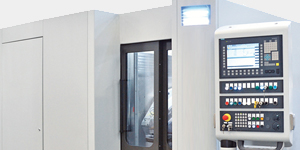
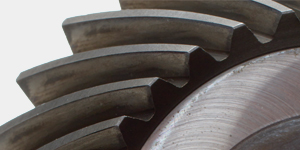



Flame hardening is a cost-effective method of providing a hard case on the teeth of gears without changing the surface chemistry. It is widely used for gears where normal heat treatment is impractical for size or cost reasons.
Introduction
Flame hardening consists of heating the surface of a part into the austenitizing region with an oxy-acetylene or similar torch and immediately quenching the part in water or polymer solution. The result is a hard martensitic case surrounding a softer ferrite-pearlite core. No change in composition results. To achieve proper hardening, the steel must have adequate carbon present to achieve the desired hardness. The rate of heating, and the conduction of heat into the interior of the part is more important than steel hardenability. Depths of hardening from 0.8 to 6.4 mm or more can be achieved through proper selection of gas, duration of heating, steel hardenability and the design of the flame head.
Flame hardening is used when parts are so large that conventional heat treating would be impractical or uneconomical. This method is also used when only a small portion or section of a part is to be hardened. Often, low distortion of a part is difficult to obtain by conventional heat treatment. Large gears where only the teeth are to be hardened are a good example of the use of flame hardening. Low alloy materials which contain adequate carbon to achieve hardness can be used to achieve a cost savings.

Process Fundamentals
Flame hardening of gears uses an oxy‑fuel flame (commonly oxy‑acetylene or oxy‑natural gas) to raise the tooth surface to the austenite range, typically about 1,450–1,600°F (788–871°C), followed immediately by water or polymer spray quenching to form martensite at the surface. The method is classified as a surface-hardening process because only a controlled depth of material is transformed, with the core remaining in a softer, tougher condition that preserves bending strength and impact resistance [1] [2].
Heating time is on the order of a few seconds per tooth in tooth‑at‑a‑time systems, or a few revolutions in spin‑hardening systems, which limits bulk heating and distortion. Close control of flame power, dwell time, and quench delay is critical to minimize grain growth and retain dimensional accuracy in precision gearing [1] [2].
Flame hardening is simple, and yet very versatile. This flexibility allows many different types of flame hardening to be performed. Typically, flame hardening can be grouped into three general methods:
- Tooth-at-a-time flame hardening.
- Progressive.
- Spinning.
Tooth-at-a-time hardening is locally heating a single location on the part with a suitable flame and quenching. Quenching can be by immersion or by spray. The proper flame head must be used (or multiple flame heads if the area is large) and balanced so that the area is uniformly heated. Heating times are often on the order of 1–5 s per tooth, with the flame scanning the flank and root region followed by an almost instantaneous quench from an integrated spray. In spin‑hardening of smaller gears, the gear may rotate at roughly one revolution per second, with heating taking several revolutions until the monitored surface temperature reaches the austenitizing setpoint, followed by immediate immersion or spray quenching [3].
The flame heads used for tooth-at-a-time hardening are shaped to follow the profiles of a single tooth. The flank and tip are most often heated, with the root occasionally heated, depending on the design requirements. The heads are typically brass with many small oxy-fuel ports. These are often coupled with a spray nozzle for the quenchant. The quenchant is either water or a polymer quenchant, depending on the hardenability of the material.
Progressive flame hardening is used to harden large areas. The flame head or multiple flame heads are mounted on a moveable platform. The flame is progressively played over the part until the entire surface is heated. Often a quench spray head follows the flame head. Progressive band hardening of shafts and large gear rims uses slower traverse rates, typically on the order of 0.8–5 mm/s for an oxy‑acetylene torch, which sets the effective heating time for each surface element and thus the resulting case depth. When the flame head width equals the band width, a single revolution or pass can harden the full band, but care is required at overlaps to avoid soft zones or over‑heated bands at the junctions [4].
The rate of travel of the flame head is dependent on the heat capacity of the head, the depth of case required, and the alloy being processed. Water or a polymer-water solution is used as the quenchant.

In the spinning method, the flame head is held stationary, and the part is rotated. Rotation can be horizontally or vertically. After the part has been heated, it is then quenched using a spray of water or polymer-water or is immersed. The spinning method is well-suited to automation.
For small and medium gears, spin hardening will use one or more flame heads aimed at the gear teeth. In addition to spinning the gear, some axial motion of the gear may be used to ensure that the entire length of the gear is covered. For particularly wide gears, multiple flame heads can be incorporated.
Typical process control for flame hardening involves control of oxygen and fuel flow, quench flow, and bath temperature, along with non‑contact infrared pyrometers to monitor surface temperature. The preheat temperature, austenitizing temperature at quench, and the residual temperature exiting the quench are controlled and recorded. Often, the hardness is taken on the as-quenched parts to establish the proper tempering cycle.
Alloys used for Flame Hardening
In general, flame hardening requires an adequate carbon content to achieve a hardness of approximately 55-60 HRC. Since the ultimate hardness is governed by the carbon content, this means that steels with a carbon content greater than 0.40 percent C are used. However, excessive carbon content can lead to quench cracking.
Chromium and molybdenum steels (such as SAE 4140) are used to improve hardenability and improve case depth. The steels should be clean with low sulfur and phosphorus to prevent cracking and improve fatigue resistance. One critical item that is often neglected is that the gears should have an appropriate prior microstructure to provide uniform heat-treatment response. Normalized or quench and tempered prior microstructures are most used to minimize cracking, uniform response, and good distortion control.
Conclusions
In this article, an overview of the process of flame hardening has been given. Typical alloys, and process fundamentals were provided. Flame hardening is a cost-effective process to achieve wear-resistant gear teeth when size or cost prohibit traditional heat treatment.
Should you have any questions regarding this article, or suggestions for additional columns, please contact the writer or editor.
References
- B. Curry, “Flame Hardening Gears,” Thermal Processing, no. April, pp. 52-53, 2014.
- M. Sirrine, “Flame Hardening,” Gear Solutions, no. October, pp. 69-78, 2015.
- J. R. Burg, “Flame Hardening Methods and Techniques,” Journal of the American Society for Naval Engineers, vol. 61, no. 1, pp. 256-269, February 1948.
- M. S. Rosengren, “Flame Hardening – Principles, Applications, and Equipment,” Journal of the American Society for Naval Engineers, vol. 60, no. 4, pp. 718-726, 1948.


